
The New Reality of Investment Banking Recruiting for Non-Target Students
New York, USA – September 15, 2026 – The advantage of attending a target university in investment banking recruiting goes beyond the name at the top of a resume. Students may have easier access to upperclassmen who have completed banking internships, established finance clubs, alumni across the industry, and more familiarity with how different firms, offices, and groups recruit. These resources can provide an early head start, particularly when it comes to understanding how and when to prepare.

A student at a non-target university may be equally capable of competing for an investment banking role while beginning with far less of that infrastructure. As the 2027 investment banking summer analyst cycle has continued the industry’s shift toward earlier recruiting, students have less time to figure out a process their campuses may not be designed to explain. The difference is not simply prestige. It is the amount of accumulated recruiting knowledge surrounding the student.
The target-school advantage goes beyond the name
A strong campus finance ecosystem can make certain parts of recruiting more accessible. Upperclassmen may share interview materials, alumni can offer perspective on different roles, and finance clubs can help students understand the recruiting process. None of that appears on a transcript nor does it guarantee an offer, but it can make recruiting easier to navigate
However at a non-target university, there may be fewer precedents. If few students have recently recruited for a particular office or group, basic questions become harder to answer: When should networking begin? Who is worth contacting? Which opportunities should be prioritized? What experience should a student have before applying
This matters because U.S. investment banking recruiting is not one standardized process. Networking expectations, interviews, and candidate profiles can differ across offices and groups. For students at schools with fewer historical placements, determining which advice actually applies to them can become part of the recruiting process itself.
A different starting point requires a different strategy
Trying to replicate the target-school recruiting playbook is not always the best answer. Networking is one example. A student with a large banking alumni base may meet relevant professionals through campus events, finance clubs, and older students. A non-target student may need to create those opportunities independently by expanding beyond a smaller alumni network and being more deliberate about whom they approach.
Experience can play a similar role. When a university is less familiar within an investment banking recruiting pipeline, internships, coursework, student organizations, and demonstrated industry knowledge can help tell a clearer story about why the candidate is pursuing the role. The objective is not to collect as many finance-related lines on a resume as possible. Each experience should help build a credible progression toward the job the student eventually wants.
Starting earlier can give students more time to build that progression. Accounting and valuation can be studied intensively, but relevant experience, industry knowledge, and professional relationships take longer to develop. For a non-target student, the purpose of starting early is not necessarily to get ahead of someone at a target school. It is to create enough time to build resources that may already exist around that student.
Recreating recruiting infrastructure
That gap is one area One Strategy Group, or OSG, says it tries to address through its investment banking career coaching. OSG says its students have accumulated more than 3,500 offers across its programs, but the more useful information for a non-target student can be the individual recruiting processes behind that number. Those outcomes provide precedents across different universities, backgrounds, offices, groups, and roles.
Instead of asking only what students from one university have historically done, a candidate can look at students who began from similar positions. When did they start preparing? What experience did they build before applying? How did they position their background? Which parts of the process created problems?
The same principle applies to preparation. Telling a student to “network more” is less useful than determining when to begin, whom to approach, and how to prepare for those conversations. If the gap is technical knowledge, the focus may instead be accounting, valuation, or industry training. If the student understands the material but lacks interview experience, repeated practice and feedback may matter more.
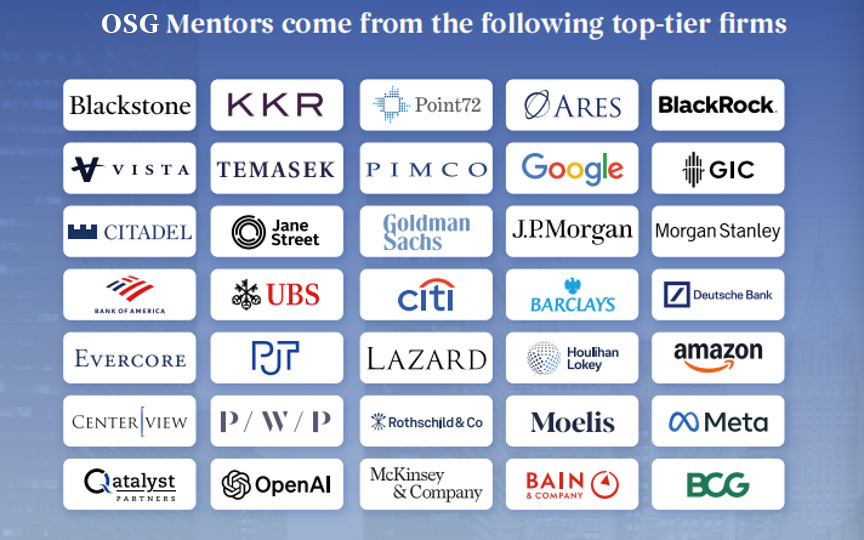
OSG uses a multi-mentor structure to address those different needs, with specialists across technical skills, industry knowledge, behavioral interviews, networking, and interview preparation. Repeated mock interviews and in-person simulations can also provide exposure to an interview environment that students at established finance pipelines may otherwise encounter through older classmates, alumni, or campus organizations. The goal is not to give non-target students an easier recruiting process. It is to reduce the extent to which access to preparation depends on where they happen to attend university.
The standard does not change
Once the interview begins, a candidate still has to perform. A non-target student has to demonstrate technical knowledge, communicate clearly, explain previous experiences, and show a credible understanding of the role. Better information can help someone prepare for that moment, but it cannot answer the questions for them.
That distinction is central to the idea of leveling the playing field. Equalizing access to information and preparation is not the same as equalizing outcomes. Students still compete for limited positions, and employers still decide whom to hire.
Where a student attends university can shape the beginning of investment banking recruiting. It can influence access to alumni, campus recruiting, student organizations, and years of accumulated recruiting knowledge. Students without those advantages may have to be more deliberate about building them elsewhere.
Leveling the playing field does not mean leveling the outcome. It means giving more candidates the opportunity to arrive prepared to compete for it.
About Us
One Strategy Group (OSG) is a leading career consulting firm guiding the next generation of leaders pursuing careers in global finance, consulting, and technology.
Founded in 2018, OSG is headquartered in the United States but has established a strong reputation among students in top universities across North America, the UK, and APAC regions through one-on-one mentorship, high offer conversion rates, and structured support systems.
Behind our results is a rigorous system: Our leadership and mentorship teams span the U.S., UK, and China, and include ex-employees from top firms such as Goldman Sachs, McKinsey, and Blackstone. We offer real-time, cross-time-zone career coaching backed by extensive industry expertise.
Media Contact
Company Name: One Strategy Group (OSG)
Contact Person: Leon
Email: Send Email
Country: United States
Website: https://www.onestrategygroup.com/


